Skip to content

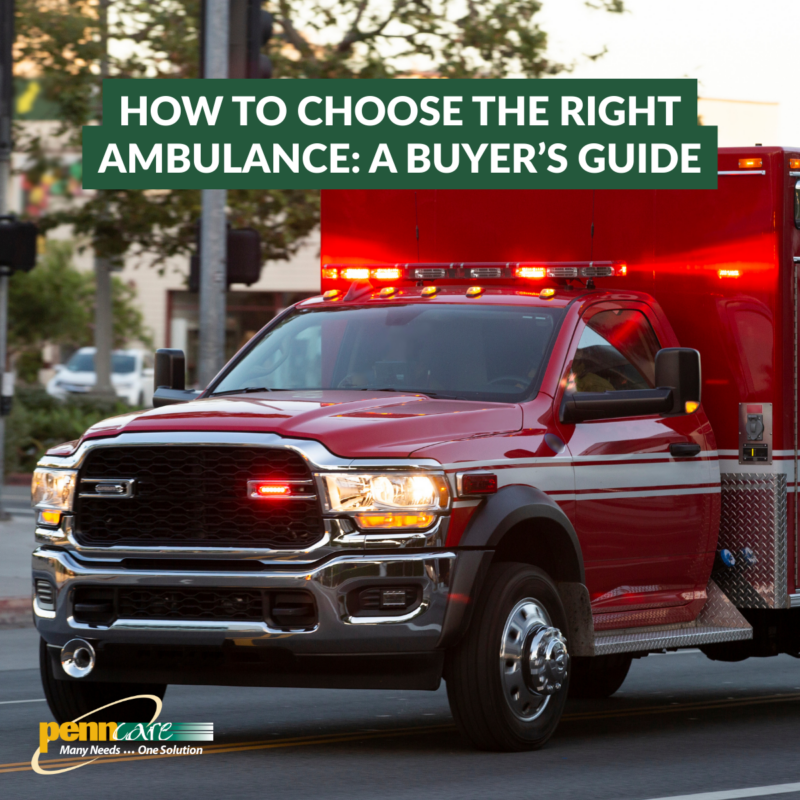
Choosing an ambulance is a strategic decision that affects patient care, crew safety, operational efficiency, and long-term fleet costs. With multiple ambulance types, manufacturers, and configuration options available, understanding how these elements compare is essential before making a purchase.
We designed this guide to help EMS agencies and departments evaluate their options thoughtfully by explaining ambulance types, outlining key decision factors, and comparing leading ambulance manufacturers based on how they are actually used in the field.
What Should You Consider When Choosing an Ambulance?
When selecting an ambulance, a vital factor to consider is how well the vehicle supports your agency’s day-to-day operations—not just today, but for years to come.
Key considerations include:
- The type and volume of calls your team responds to
- The geography and terrain you serve
- Crew size, workflow, and shift length
- Equipment, storage, and power requirements
- Budget and total cost of ownership expectations
Remember: The right ambulance should fit your EMS agency’s operations, not force you to make compromises.
What Are the Different Types of Ambulances?
At Penn Care, we supply an inventory of three ambulance types: Type I, Type II, and Type III. Each type is built on a different chassis and designed for specific operational environments.
What Is a Type I Ambulance Best Used For?
Type I ambulances are built on a heavy-duty truck-like chassis with a modular, box-style patient compartment.
They are best suited for:
- Advanced Life Support (ALS) operations and rescue work
- High-acuity response units
- Rural or mixed-terrain environments
Advantages
- High payload capacity
- Spacious patient compartment
- Strong performance in demanding conditions
- Highly recognizable in the industry
Trade-offs
- Larger footprint
- Reduced maneuverability in dense urban areas
When Is a Type II Ambulance the Right Choice?
Type II ambulances are built on a commercial van chassis and prioritize efficiency and maneuverability. The elevated roof provides personnel with extra workspace and includes a secondary air conditioning unit at the rear for additional cooling.
They are commonly used for:
- Basic Life Support (BLS)
- Interfacility or longer transports
- Backup or secondary response units
Advantages
- Easier navigation in tight or congested terrain
- Lower operating and fuel costs
- Faster deployment for transport-focused needs
Trade-offs
- Limited space due to no separation between patient and driving compartments
- Reduced equipment and storage capacity
Why Choose a Type III Ambulance?
Type III ambulances are mounted on a cutaway van chassis paired with a square patient compartment, offering a balance between Types I and II.
They are often used for:
- ALS response in suburban or urban areas
- Agencies seeking flexibility across call types
Advantages
- Integrated cab-to-patient compartment access
- Efficient interior layouts
- Balanced maneuverability and capacity
Trade-offs
- Payload and durability may not match heavy-duty Type I units
- Slightly larger footprint than Type II ambulances
Which Factors Matter Most When Selecting an Ambulance?
Beyond ambulance type, several operational factors play a significant role in determining the best fit.
EMS buyers should evaluate:
- Call volume and response profile: Higher call volumes often require more durable platforms.
- Service area: Urban systems benefit from maneuverability, while rural agencies often prioritize power and storage.
- Crew workflow: Interior layout and ergonomics directly affect responder safety and efficiency.
- Equipment demands: Advanced equipment requires sufficient power management and storage.
- Future planning: Choosing a platform that can adapt to changing needs extends vehicle lifespan.
How Do the Top Ambulance Manufacturers Compare?
Penn Care represents five established ambulance manufacturers, each bringing a distinct design philosophy, build approach, and operational focus. Understanding how these manufacturers differ helps EMS agencies select a platform that aligns with their service demands, budget considerations, and long-term fleet goals.
Braun Ambulances: Built for High-Demand, High-Acuity Operations
Braun Ambulances is one of the most recognized names in emergency vehicle manufacturing, with decades of experience building ambulances designed for safety, durability, and long-term performance. Braun places a strong emphasis on structural integrity, advanced safety systems, and rigorous testing standards, making their vehicles a common choice in demanding EMS environments.
From an operational standpoint, Braun Ambulances are frequently used where:
- Vehicles see high call volumes
- Units remain in service for extended lifecycles
- Crew and patient safety features are heavily emphasized
Braun’s heavy-duty construction, crash-tested components, and occupant protection systems align well with agencies that prioritize risk mitigation, uptime, and fleet consistency, particularly in ALS-heavy or urban systems.
Common operational fit:
- High-acuity ALS operations
- High-volume urban EMS systems
- Fleets prioritizing safety engineering, durability, and long-term reliability
In summary: Braun Ambulances are commonly used by high-volume EMS departments that prioritize safety engineering, durability, and long-term reliability in demanding ALS environments.
Demers Ambulances: Designed for Consistency and Fleet Efficiency
Demers Ambulances is the oldest continuous ambulance manufacturer in North America and is widely recognized for designing vehicles that emphasize consistency, efficiency, and repeatable performance. Demers focuses on standardized, modular design approaches and rigorous quality controls to support predictable operation across entire fleets.
From an operational standpoint, Demers Ambulances are frequently used where:
- Multiple units must operate interchangeably
- Standardized layouts simplify training and day-to-day workflows
- Long-term uptime and operational cost control are priorities
Demers’ modular interior designs, modern systems integration, and emphasis on ease of maintenance align well with agencies seeking fleet-wide uniformity and operational efficiency, particularly in high-volume EMS environments.
Common operational fit:
- High-volume urban EMS systems
- Large municipal or private EMS fleets
- Departments prioritizing standardization, efficiency, and predictable fleet performance
In summary: Demers Ambulances are often selected by EMS systems that value standardized fleet layouts, predictable performance, and operational efficiency across multiple units.
Crestline Ambulances: Practical Performance with Long-Term Value in Mind
Crestline Ambulances brings more than 50 years of experience in emergency vehicle manufacturing, with a clear focus on durability, ergonomics, and long-term value. Crestline emphasizes practical design choices and proven construction methods that support paramedic workflow while keeping ownership costs manageable throughout the vehicle’s life.
From an operational perspective, Crestline Ambulances are frequently used where:
- Dependable performance is needed without unnecessary complexity
- Predictable ownership and maintenance costs are a priority
- Responder comfort and efficient interior layout support daily operations
Crestline’s durable construction, ergonomic interiors, and inclusion of standard features align well with agencies seeking reliable, long-lasting ambulances that deliver consistent performance without excessive customization or cost escalation.
Common operational fit:
- Mid-sized EMS agencies
- Budget-conscious departments
- Fleets focused on long service life, practicality, and value
In summary: Crestline Ambulances are frequently chosen by agencies seeking dependable, ergonomic vehicles that balance performance needs with predictable long-term ownership costs.
Medix Ambulances: Built for Agencies with Specific Operational Requirements
Medix Ambulances is known for hands-on craftsmanship, customization flexibility, and close attention to detail throughout the manufacturing process. Built in the United States, Medix vehicles are designed with direct input from EMS professionals and emphasize quality control at every stage of production.
From an operational standpoint, Medix Ambulances are frequently used where:
- Standard layouts do not fully support daily response needs
- Interior configuration directly impacts patient care and crew workflow
- A tailored vehicle solution improves efficiency or safety
Medix’s ability to accommodate custom layouts, practical interior designs, and detailed inspection processes aligns well with agencies that view their ambulances as purpose-built tools rather than standardized fleet assets.
Common operational fit:
- Agencies with specialized response or transport needs
- EMS departments requiring custom configurations
- Buyers prioritizing craftsmanship, flexibility, and build quality
In summary: Medix Ambulances are commonly used by EMS agencies that require customized vehicle layouts to support specialized workflows, equipment, or response needs.
FastLane Emergency Vehicles: Purpose-Built for Specialty and Support Operations
FastLane Emergency Vehicles specializes in custom emergency and specialty response vehicles built by first responders for first responders. FastLane focuses on streamlined production, efficient designs, and rapid turnaround while maintaining the flexibility required for highly customized builds.
From an operational standpoint, FastLane vehicles are frequently used where:
- Standard ambulance platforms do not meet operational requirements
- Specialty support, command, or rehab functions are needed
- Faster deployment timelines are critical to readiness
FastLane’s streamlined production processes and expertise in custom cabinetry, climate control, and electrical systems are well-suited for agencies in need of purpose-built support vehicles that can be quickly deployed without compromising quality.
Common operational fit:
- Specialty response and support units
- Command, rehab, and non-traditional EMS vehicles
- EMS and public safety teams requiring rapid, customized solutions
In summary: FastLane vehicles are typically deployed in specialty, command, rehab, or support roles where custom design and faster delivery timelines are critical.
Which Ambulance Is Best for Your Type of EMS Operation?
Different EMS departments prioritize different outcomes. Matching ambulance features to operational realities is key.
Best Ambulance Options for High-Volume Urban EMS Systems
High-volume systems often prioritize durability, interior workflow efficiency, and fast turnaround times to support frequent responses.
Best Ambulance Options for Rural and Mixed-Terrain Coverage
Rural agencies typically benefit from heavier-duty chassis, higher payload capacity, and enhanced suspension systems.
Best Ambulance Options for Value-Focused Buyers
Value-focused buyers often seek a balance between customization, reliability, and long-term operating costs rather than the lowest upfront price.
Best Ambulance Options for Custom or Specialty Use
Agencies with unique response needs benefit from manufacturers known for flexible configurations and specialty build capabilities.
What Trade-Offs Should EMS Buyers Expect When Purchasing an Ambulance?
Every ambulance purchase involves trade-offs, including:
- Customization versus delivery timelines
- Initial cost versus long-term durability
- Vehicle size versus maneuverability
- Fleet standardization versus operational flexibility
Understanding these trade-offs early helps avoid limitations later in the vehicle’s lifecycle.
What Do Ambulance Buyers Commonly Overlook?
Buyers often focus on vehicle specifications while overlooking factors that impact long-term success, such as:
- Post-delivery service and maintenance
- Warranty coverage and support
- Training and onboarding
- Future retrofit potential
- Access to demo units before committing
These considerations significantly affect uptime, reliability, and total cost of ownership.
How Does Penn Care Help EMS Agencies Choose the Right Ambulance?
With more than 35 years of industry experience, Penn Care helps EMS agencies navigate ambulance purchasing with clarity and confidence.
As an authorized dealer for Braun, Demers, Crestline, Medix, and FastLane, Penn Care provides:
- In-depth knowledge of ambulance models and configurations
- Demo, specialty, and pre-owned ambulance options
- Customization guidance based on operational needs
- Mobile Repair & Maintenance Ambulance Services
- Ongoing support that extends beyond delivery
Penn Care remains independently owned and committed to long-term partnerships built on reliability, experience, and service.
What Are the Next Steps After Choosing an Ambulance?
Once you understand your operational needs and available options, the next step is to continue the conversation.
For a custom quote, to schedule a demo appointment, or to discuss which ambulance configuration best fits your department, contact the Penn Care team for expert guidance.